|
Story of a strawberry and his breeder
This variety has been launched by JE Kuhns, a strawberry farmer in Cliffwood, New Jersey, which is located near the New Jersey Agriculutral Experiment Station in New Brunswick
Mr. Kuhns already cultivated varieties: GLEN MARY, Chesapeake, and LATE STEVENS; ABERDEEN he received and decided to introduce it.
M Kuhns used to test many new varieties, to breeding and selecting plants that interested him, regardless of their parent state. He regularly hundreds of seedlings tested. By 1910 he had meritorious varieties to trade. In 1963, a letter from his son, WW Kuhns, testified that his father said that one of his crosses had the vigour of the LATE STEVENS, and quality of Chesapeake and that would be promising strawberry.
For 25 years he has grown this promising variety . The seeds were sown back in the 1910s and in 1917, Mr. Kuhns had tested his selections, he had a row of ABERDEEN about 300 feet long.
In 1924.Aberdeen was reported as promising variety by JH Clarke, of the Agricultural Experiment Station, New Jersey
|
In 1927, Clarke said that he had beautiful fruit during four years successively, but in his view, the main defect was that of ABERDEEN his flesh was too soft for transport even if, as such, it surpassed the 17 HOWARD . In the 1930s, ABERDEEN was widely grown in New Jersey and other northern states.
In 1935, ANDERSON of Illinois said that Aberdeen was resistant to red stele, thus giving it a great importance. That year, AS Colby, Station Illinois Agricultural Experiment, conducted a cross MASTODON x ABERDEEN. A high percentage (63.5 percent) of the resulting seedlings were resistant to disease. Clarke, New Jersey, ABERDEEN used as a parent and obtained varieties introduced in the market as Pathfinder and SPARKLE both of which showed resistance.
Since then, the U.S. Department of Agriculture has used ABERDEEN for crossings to produce TEMPLE X FAIRFAX which was chosen in 1939 and introduced in 1943.
TEMPLE, FAIRLAND SPARKLE and replaced ABERDEEN reference variety resistant to red stele.
ABERDEEN:
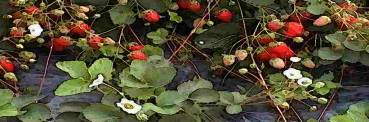
Occasionally well perfumed, it multiplies well alone, producing large red fruit, with sweet and slightly subacid taste.
|
 ACCUEIL

 ACCUEIL lescrets fruits et pomologie